
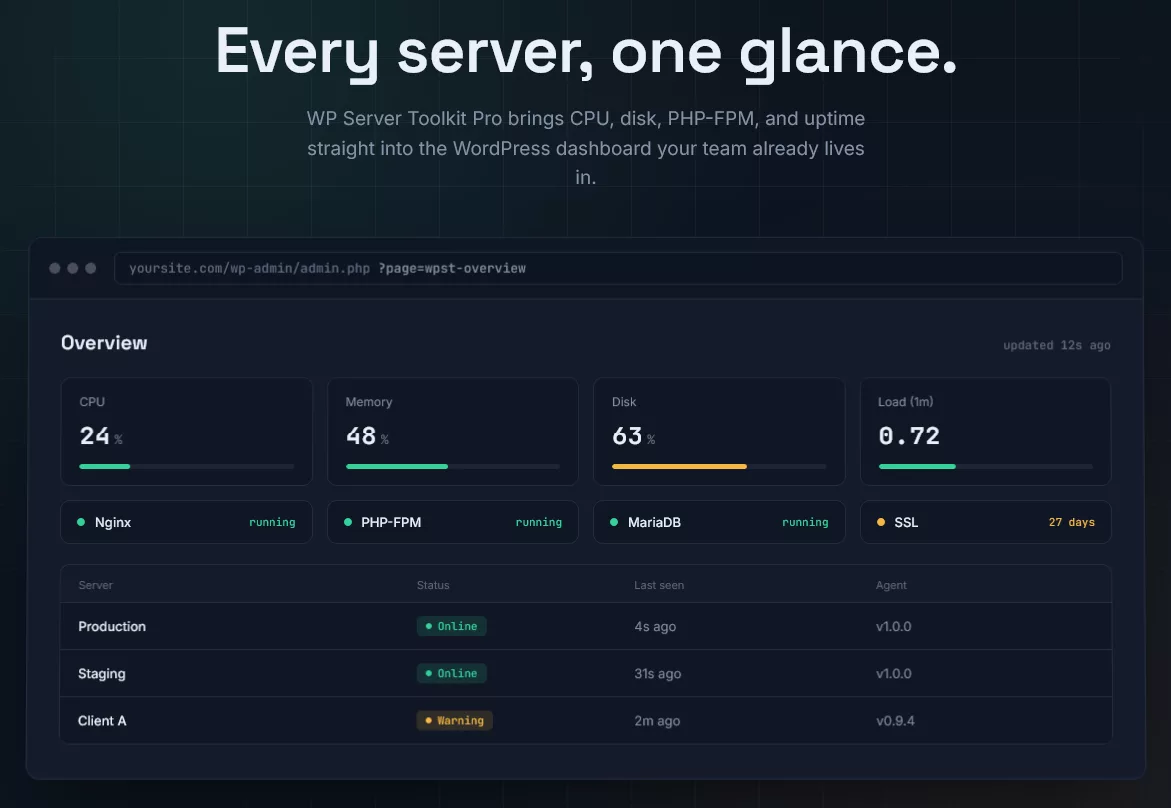
See the health of every server at a glance, without logging in over SSH.
A WordPress site depends on much more than themes, plugins and content. Its speed and stability rest on the server underneath. A busy CPU, a nearly full disk, a stopped service or an SSL certificate about to expire can hurt your visitors long before you notice. Most owners find out only after something breaks.
WP Server Toolkit puts server and WordPress health monitoring inside the admin area you already use. You no longer have to hop between terminals and separate monitoring tools. The key information about your hosting environment sits in one familiar dashboard.
It is designed for real hosting setups. It works for one site and for a whole portfolio of client servers, and it warns you early so small problems don’t grow. If you manage several installs, it pairs well with a multisite network setup.
What Is WP Server Toolkit?
WP Server Toolkit has two parts. The first is a WordPress plugin that provides the dashboard, alerts, history and WordPress-specific checks. The second is an optional lightweight agent for Linux, which runs on your server and securely sends system metrics back to the plugin.
Together they cover both the application layer and the server layer. You can follow CPU load, memory, disk space, load average, network traffic and running processes. You can also check that essential services such as Nginx, PHP-FPM and MySQL or MariaDB are up. If you are still building that stack, see this guide to installing Nginx, PageSpeed, MariaDB and PHP.
Inside WordPress, the plugin checks debug mode, WP-Cron reliability, file permissions and error logs. It also tracks SSL certificate expiry, so a lapsed certificate never catches you off guard. Need a free certificate? Let’s Encrypt is a popular option. Need help getting one in place first? Read how to install an SSL certificate.
Key Features
- Resource monitoring. Track CPU spikes, memory pressure, disk usage and load averages, in real time and over time. Network and process data show what is happening under the surface.
- Service status. See at once whether Nginx, PHP-FPM and MySQL/MariaDB are running. This helps most when a site slows down or throws errors and WordPress itself isn’t the cause, such as a 500 internal server error.
- WordPress health checks. The plugin flags debug mode left on, a failing WP-Cron, risky file permissions and other common WordPress errors.
- Smart error tracking. It reads your debug log and groups repeated PHP and WordPress errors, so you see each distinct issue once instead of a wall of duplicates.
- SSL expiry monitoring. Get a warning well before a certificate lapses and visitors see browser security alerts.
- Multi-server management. Register several Linux servers, organize them with tags or groups, and manage them all from one WordPress installation. Agencies, freelancers and anyone running production and staging environments will find this especially useful.
- Flexible alerts. Receive notifications by email, Telegram or webhook. Duplicate alerts are suppressed, and you get a recovery notice when an issue clears.
- Historical data. Metrics are saved and summarized by the hour and by the day. You choose the retention period, so your database stays a manageable size.
- Security findings. Relevant WordPress and Linux checks are reported as findings, not guarantees. You stay informed without being given false confidence. Pair them with a solid WordPress security checklist.
Why Use WP Server Toolkit?
Many WordPress and WooCommerce owners only react once customers complain. This toolkit lets you act earlier:
- Spot heavy resource usage before the site slows down.
- Notice a full disk before uploads start failing. Related reading: how to raise the maximum upload file size.
- Catch a stopped service before the site goes offline.
- Renew an SSL certificate before browsers show warnings.
It also reduces how often you need SSH. Routine health checks and trends are available in the WordPress admin, which saves time and lowers the chance of mistakes on a production server. With several servers, one central view replaces many separate logins. Good monitoring also helps you judge whether your WooCommerce hosting is keeping up, or whether it is time to compare Nginx and LiteSpeed and tune performance with Nginx optimization.
Security is built in. The Linux agent reports through a small set of fixed endpoints. It offers no remote shell and no arbitrary command execution, and the dashboard cannot send free-form commands to your servers. Setup uses short-lived, single-use registration tokens, so no permanent secret is ever typed into the command line.
How It Works
- Install the plugin. Upload and activate it like any other WordPress plugin. The overview and WordPress health screens work straight away, even before you connect a server.
- Add a server. Open the Servers section and create a new entry. The plugin generates a temporary registration token.
- Run the install script. On your Linux server (Ubuntu or Debian recommended), run the install script with that token. The agent registers itself securely and begins reporting.
- Monitor and configure. View system status, service health, resource trends and alerts. Set up notification channels, choose how long data is kept, and group servers with tags.
The interface follows normal WordPress conventions, so there is no new monitoring platform to learn.
Who Is It For?
- Site owners who want early warnings and peace of mind.
- Agencies and freelancers who look after several client servers.
- Developers and system administrators who want solid visibility without building a custom monitoring stack.
- Anyone hosting WordPress on Linux who wants clearer insight into server health.
It is especially helpful if you now rely on occasional SSH checks or a patchwork of separate tools. It also belongs on any list of must-have WordPress plugins for site owners who care about uptime.
Security-First Design
Monitoring software can add risk if it is built carelessly, so this toolkit keeps its exposure small. The agent offers only limited monitoring endpoints, covering system, memory, disk, network, processes, PHP, PHP-FPM, Nginx, MySQL and security data. None of them can run arbitrary commands.
Registration tokens expire quickly and work only once. The agent swaps the temporary token for a permanent bearer token and stores it with restrictive file permissions. The result is useful data without unnecessary remote-control capability. If a site is ever compromised, early warnings also make it easier to recover a hacked WordPress site.
Open to Contributions
WP Server Toolkit is an open project, and contributions from developers, agencies and site owners are welcome. You can help by:
- Reporting bugs and edge cases, especially on other Linux distributions or behind reverse proxies and security plugins.
- Improving documentation and the installation experience.
- Adding new collectors or health checks that respect the no-arbitrary-execution rule.
- Polishing the admin interface.
- Strengthening tests and hardening the REST API and agent communication.
To contribute, fork the repository, create a focused branch, make clear commits, and open a pull request that describes the change and any risks. Please keep the security model intact: no free-form remote command execution, and careful handling of registration and bearer tokens.
Final Thoughts
Good server monitoring should not feel complicated. WP Server Toolkit brings Linux metrics, service status, WordPress health, SSL tracking, alerts and multi-server support into one practical dashboard. It helps you catch problems early, cuts down on SSH checks and keeps security in view.
Whether you run one site or many, install it, connect your servers and see the full picture from the place you already work.