WordPress now powers more than 40% of all websites (see W3Techs’ live usage data and our own breakdown of the percentage of websites using WordPress). That popularity creates a problem for site owners: great WordPress developers are in high demand, in-house hires are expensive, and one bad hire can cost months. That is why more businesses are turning to WordPress outsourcing services to get expert work done faster and at a predictable cost.
This guide shows you how to outsource WordPress web development services the smart way. You’ll get the 5 outsourcing models, realistic price ranges, a 7-step process, red flags to avoid, contract must-haves, and a hand-checked list of 19 agencies that offer outsourcing service for WordPress projects of every size.
Key takeaways
- Outsourcing WordPress work typically saves 30-60% versus building a comparable in-house team, but only when scope, ownership and communication are clear.
- Pick the engagement model first (fixed-price, dedicated team, staff augmentation, white-label or retainer), then the agency.
- Run a paid pilot of 2-4 weeks before committing to a large build.
- Insist on Git, staging, and written IP assignment. These three protect you more than any price discount.
- Use the comparison table below to shortlist 3 agencies, then request written quotes from each.
What Are WordPress Outsourcing Services?
WordPress outsourcing services are paid services where an external agency, studio or specialist team handles part or all of your WordPress work. If you are new to the platform, start with our explainer on what WordPress is. Outsourced work usually falls into these buckets:
- Website builds: design, development and launch of a new site (see our guide to creating a WordPress website).
- Custom themes and plugins: bespoke features that off-the-shelf products can’t deliver. Review our WordPress theme standards so you know what good code looks like.
- WooCommerce development: stores, checkout customizations and integrations. Browse real WooCommerce website examples for inspiration.
- Migration and redesign: moving from Wix, Shopify, Joomla or legacy PHP to WordPress.
- Performance and security: speed tuning, hardening, and recovery (see WordPress security checklists and how to recover a hacked WordPress site).
- Maintenance and support: updates, backups, bug fixes and monitoring.
Why Outsource WordPress Development?
Outsourcing isn’t right for every project, but these are the reasons businesses choose to outsource WordPress development services:
1. Lower and more flexible cost
A senior in-house developer carries salary, benefits, equipment, management time and recruiting costs. With outsourcing you pay for output, and you can scale spend up or down as projects start and finish.
2. Faster access to specialist skills
WordPress work spans PHP, JavaScript and React for blocks, REST API, WooCommerce, performance, accessibility and security. A good agency brings all of these together, so you don’t have to hire five separate specialists. If you want to know what skills are involved, our WordPress development frameworks and back-end developer roadmap posts are a good primer.
3. Speed to market
Established teams have processes, reusable components and QA routines. That usually means a launch in weeks rather than the months a new hire would need to ramp up.
4. Focus on your core business
Founders and marketers should spend time on customers and strategy, not debugging a plugin conflict. For common problems you can also check our list of common WordPress errors.
5. Risk sharing
Reputable agencies carry processes for code review, testing and rollback. If one developer is sick, the project continues.
When NOT to outsource
Keep work in-house when the site is your core product and changes daily, when you handle highly regulated data that can’t leave your environment, or when you have no one able to review the agency’s work. In those cases a hybrid model (in-house lead + outsourced developers) is safer.
5 WordPress Outsourcing Models (and Which to Choose)
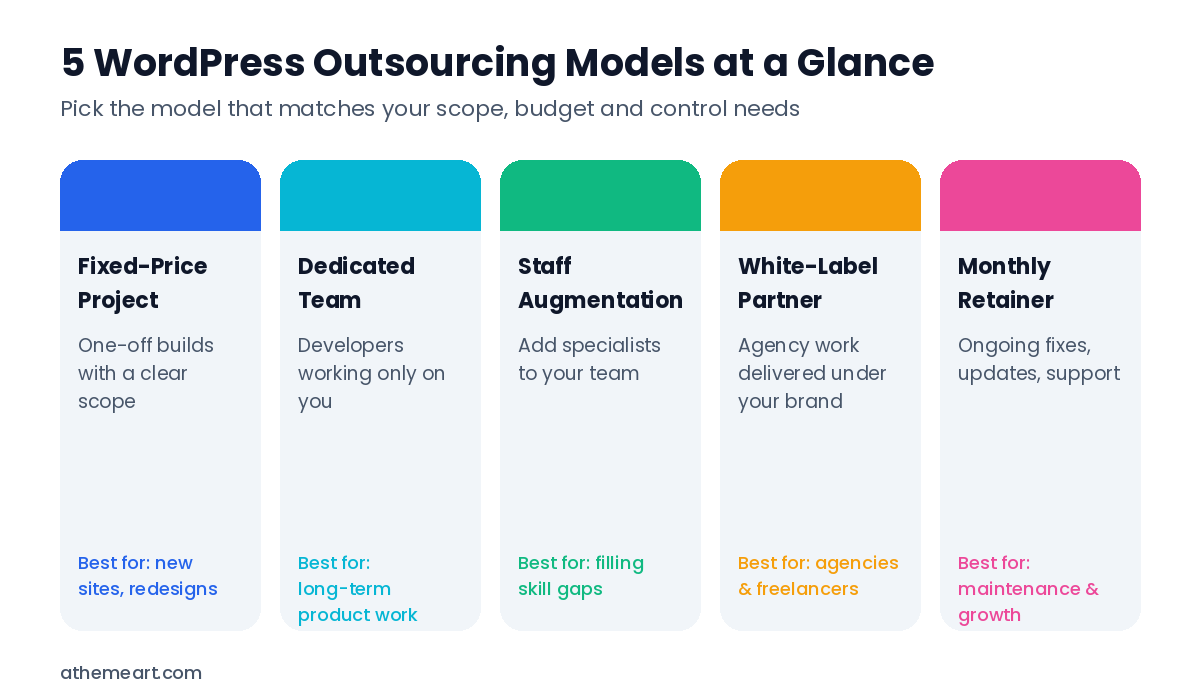
| Model | How it works | Best for | Watch out for |
|---|---|---|---|
| Fixed-price project | Agreed scope, timeline and price | New sites, redesigns, one-off plugins | Scope creep triggers change-request fees |
| Dedicated team | Developers work only on your roadmap, billed monthly | Long-running products, SaaS-style WordPress builds | You must supply direction and priorities |
| Staff augmentation | Specialists join your team and tools | Filling skill gaps temporarily | Needs strong internal management |
| White-label partner | Agency delivers work you resell under your brand | Freelancers and agencies without capacity | Quality reflects on you, so vet carefully |
| Monthly retainer | Fixed hours for updates, fixes and improvements | Maintenance, small features, support | Unused hours may expire |
Rule of thumb: choose fixed-price when you can describe the end result in detail, and choose dedicated team or retainer when requirements will evolve.
How Much Does WordPress Outsourcing Cost?
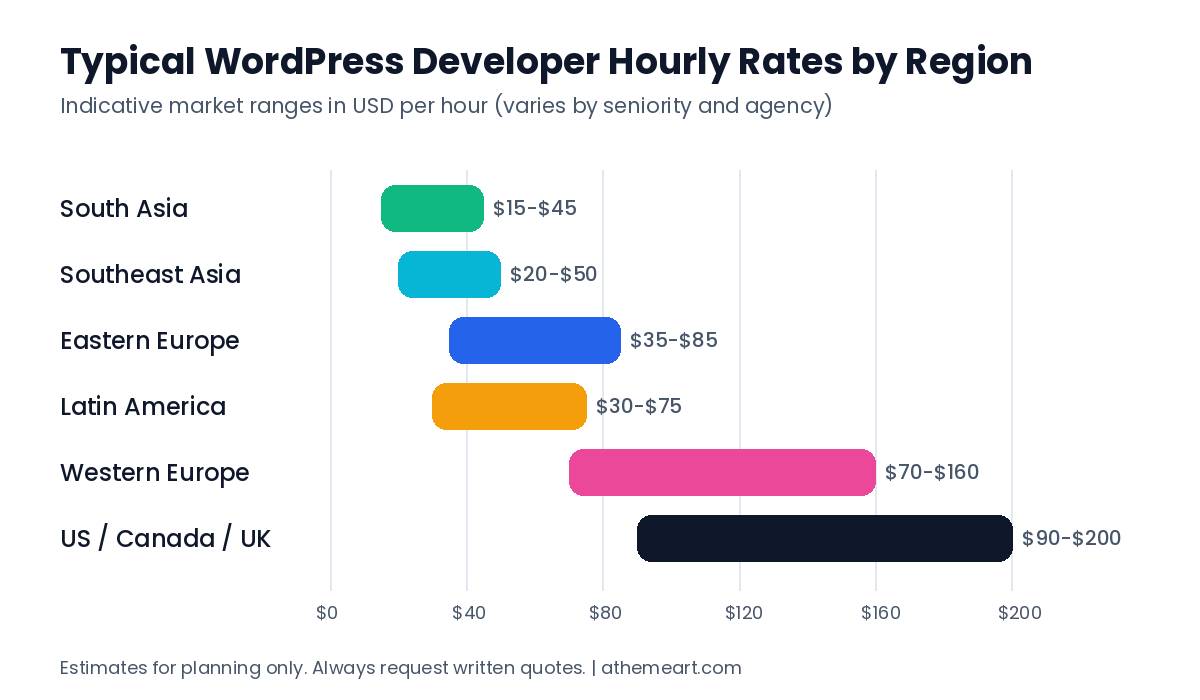
Prices vary widely by region, seniority and scope. The chart and ranges below are indicative market estimates for planning, not quotes. Always request written proposals. For help estimating your budget, read our guide on how to get a web development quote.
| Project type | Typical fixed-price range (USD) | Typical timeline |
|---|---|---|
| Brochure / small business website | $1,500 – $6,000 | 3-6 weeks |
| Custom-designed business website | $5,000 – $25,000 | 6-12 weeks |
| WooCommerce store with customizations | $8,000 – $50,000+ | 8-16 weeks |
| Custom plugin or integration | $3,000 – $30,000+ | 3-12 weeks |
| Enterprise / headless / multisite | $50,000+ | 4-9 months |
| Maintenance retainer | $50 – $1,000+ per month | Ongoing |
What drives cost up: custom design instead of a template, complex integrations (CRM, ERP, payment gateways), multilingual sites, strict accessibility requirements and aggressive deadlines. What lowers it: a well-written brief, reuse of a quality theme (see WordPress theme providers and free WordPress themes) and fast feedback cycles.
How to Outsource WordPress Development in 7 Steps
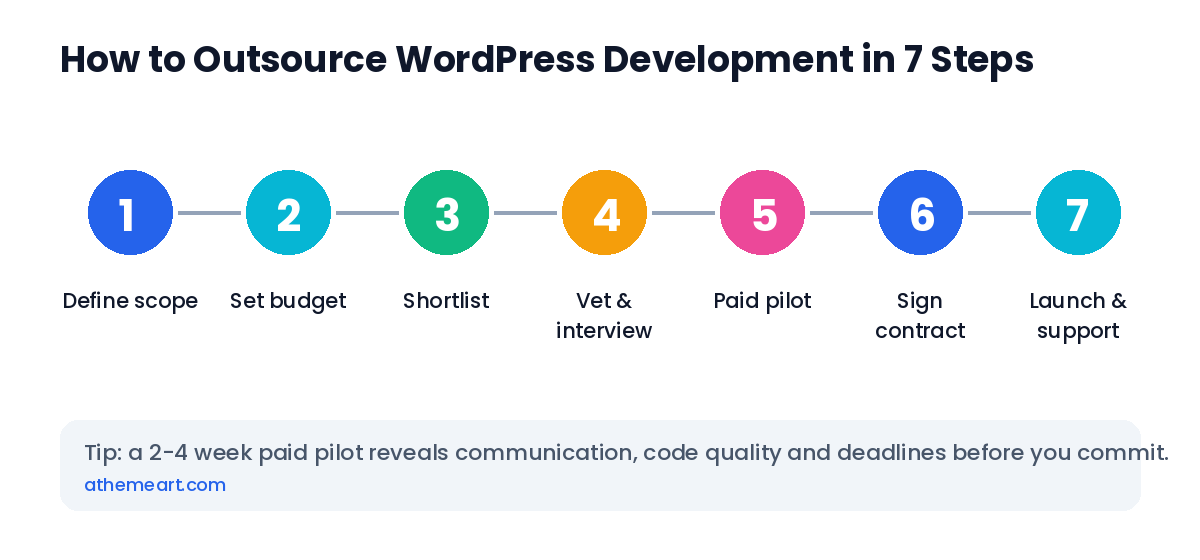
- Define scope. List pages, features, integrations, devices and success metrics. Write “must-have” and “nice-to-have” separately.
- Set a budget range and deadline. Share the range with serious vendors. It filters out mismatches early.
- Shortlist 3-5 agencies. Use the list below, then check portfolios for projects similar to yours.
- Vet and interview. Ask who will actually work on your project, how code is reviewed, and how they handle bugs after launch.
- Run a paid pilot. A small 2-4 week task (a landing page, a bug backlog, a plugin tweak) shows real communication and code quality.
- Sign a clear contract. See the checklist in the contract section below.
- Launch, measure and support. Plan QA, performance checks and a 30-day warranty period. Follow our beginner’s guide to WordPress on-page SEO so the new site is ready to rank.
How to Evaluate a WordPress Outsourcing Partner
Score every shortlisted agency from 1-5 on each of these criteria:
- WordPress specialization: Do they contribute to core, publish plugins or speak at WordCamps? Check Make WordPress and the WordPress.org plugin directory for their names.
- Code quality: Do they follow the official WordPress coding standards? Ask for a code sample and use version control (see version control for WordPress plugins).
- Security practices: Do they sanitize, escape and validate data? Our post on sanitizing, escaping and validating explains what to ask.
- Performance focus: Ask for Core Web Vitals results from past projects. Learn what good hosting looks like in optimizing performance with Nginx and the fastest WordPress themes.
- SEO awareness: Clean markup, schema, redirects and speed matter. See the best platform for SEO.
- Communication: Time-zone overlap, response time, English (or your language) fluency and a named project manager.
- References and reviews: Talk to two past clients, ideally with a similar project size.
- After-launch support: Warranty period, SLA for critical bugs, and maintenance plans.
19 Best WordPress Outsourcing Agencies
Disclosure: Athemeart is our own company and is included in the list. The order below is not a ranking. Agencies are grouped loosely by their strengths. Services, locations and pricing change, so confirm details on each agency’s own website before you decide.
Enterprise and WordPress-specialist agencies
1. 10up
10up is one of the best-known WordPress-focused agencies, with a distributed team that combines design, engineering and strategy. It is a frequent choice for content-heavy publishers and large brands that need performance, editorial workflows and long-term partnership rather than a quick build.
2. WebDevStudios
WebDevStudios is a WordPress-only agency known in the community for its open-source tools, including the popular CMB2 and Custom Post Type UI plugins. Its solutions page covers custom development, WooCommerce, support and strategy for organizations that want an engineering-led partner.
3. XWP
XWP is an engineering-led WordPress agency recognized for its work on the official AMP plugin for WordPress and for large-scale platform projects. Consider XWP if you need deep PHP and JavaScript expertise, headless architectures or performance-critical builds.
4. Multidots
Multidots is an India-based WordPress agency that serves international clients with enterprise-grade development, WooCommerce work and ongoing support. It’s a common pick for businesses that want senior WordPress skills with a lower cost base than Western agencies.
5. DevriX
DevriX is a WordPress agency with Bulgarian roots that offers development, design and marketing services. It often partners with companies on multi-year engagements, from builds to growth and maintenance.
6. Computan
Computan is a US-based agency that builds WordPress sites together with digital marketing and conversion work. A reasonable fit if you want development and growth services from a single partner.
7. WPRiders
WPRiders is a Romania-based WordPress development company. It focuses on custom plugins, performance work and ongoing support, making it a candidate for agencies looking for a reliable back-end partner.
Design-led and brand-focused agencies
8. Wholegrain Digital
Wholegrain Digital is a UK agency known for sustainable web design and for building low-carbon, fast WordPress sites for mission-led organizations. Choose it when environmental impact, accessibility and brand values are part of your brief.
9. Shakuro
Shakuro is a design and development studio with a strong visual design reputation. Consider it when interface quality and brand experience matter as much as the WordPress back end.
10. Moove Agency
Moove Agency designs and builds WordPress websites and is also the team behind the widely used GDPR Cookie Compliance plugin. Its plugin background is useful if privacy, consent and custom functionality are central to your project.
11. Social Driver
Social Driver is a Washington, DC agency that combines website design and development with communications, advocacy and content strategy. It lists a WP Engine agency-directory profile and works heavily with associations and nonprofits.
12. Swiss Tomato
Swiss Tomato is a Swiss agency with offices in Geneva and Zurich that builds websites on WordPress and Drupal, plus mobile apps and AR/VR experiences. A good match for B2B and nonprofit teams that want one partner for web and app work, and who value local, French, German and English support.
13. Agence 33 Degrés
Agence 33 Degrés is a French web agency. If your audience, content and stakeholders are French-speaking, a local partner can simplify communication, legal requirements and SEO for French search.
Cost-effective, white-label and product-focused teams
14. CSSChopper
CSSChopper is an India-based agency known for turning designs into WordPress themes, along with customization and plugin work. It is often used by freelancers and agencies who need reliable overflow capacity at lower rates.
15. CemtrexLabs
CemtrexLabs builds digital products across user experience design, mobile, IoT and web engineering, with web engineers working in JavaScript, PHP, Python and Ruby. It is not a WordPress-only shop, so it suits projects where WordPress is one part of a larger product. Confirm WordPress experience with relevant case studies.
16. The Free Website Guys
The Free Website Guys runs a program that builds websites for entrepreneurs at no charge, accepting only a share of applicants, and monetizes through additional paid services. It also advertises white-label WordPress development. Read the program terms carefully so you know exactly what is included and what costs extra.
17. IntellRocket
IntellRocket offers web development services, including WordPress work. As with any smaller vendor, ask for recent case studies, named developers and references, and start with a pilot task.
18. BragDeal
BragDeal provides web development and related digital services. Check its portfolio for WordPress projects similar to yours and request a written scope and quote before committing.
Themes, plugins and WooCommerce customization
19. Athemeart (us)
Athemeart builds WordPress themes and plugins for WooCommerce and Easy Digital Downloads stores, including conversion tools such as AI Sales Notifications for WooCommerce. We publish extensive guides on theme selection, WooCommerce plugins and WordPress development, such as our roundups of must-have WordPress plugins and essential WooCommerce plugins. If you need a theme or plugin tailored to your store, get in touch with the Athemeart team.
Agency Comparison Table
| Agency | Strength | Best for |
|---|---|---|
| 10up | Enterprise WordPress, publishing | Large content sites |
| WebDevStudios | Open-source tools, custom builds | Engineering-led projects |
| XWP | Engineering depth, AMP plugin work | Complex or headless builds |
| Multidots | Enterprise skills, offshore value | WooCommerce and enterprise |
| DevriX | Long-term WordPress partnerships | Retainers, growth |
| Computan | Development plus marketing | US businesses |
| WPRiders | Custom plugins, support | White-label back-end |
| Wholegrain Digital | Sustainable, accessible design | Mission-led brands |
| Shakuro | UI/UX design | Design-heavy products |
| Moove Agency | Plugin expertise | Privacy and compliance features |
| Social Driver | Websites plus communications | Associations, nonprofits |
| Swiss Tomato | Web, apps, AR/VR | Swiss/European organizations |
| Agence 33 Degrés | French-language delivery | French-speaking markets |
| CSSChopper | Design-to-WordPress conversion | White-label overflow |
| CemtrexLabs | Multi-platform product building | Web + mobile + IoT products |
| The Free Website Guys | Free starter sites, white-label | Startups, first website |
| IntellRocket | General web development | Small projects |
| BragDeal | General web services | Budget projects |
| Athemeart | Themes, plugins, WooCommerce tools | Store owners, theme/plugin needs |
Red Flags to Avoid
- “Unlimited revisions, fixed price, 3-day delivery.” If it sounds impossible, something will give, usually quality.
- No named developers. You should know who writes your code and who is accountable.
- Nulled or pirated themes and plugins. These routinely contain backdoors. Read our hacked-site recovery guide to see how costly that can be.
- Page-builder-only portfolio. Fine for simple sites, but a problem if you need custom logic.
- Refusal to use staging or Git. Editing a live site directly is a common cause of downtime.
- Vague ownership language. Without written IP assignment, the agency may legally retain rights to custom code.
- Hidden recurring fees. Ask about hosting, licenses, maintenance and “support” charges up front.
- No post-launch plan. Bugs appear after launch. Make sure a warranty period is in writing.
Contract and Security Checklist
Put these in writing before work starts
- Scope and deliverables: pages, features, browsers, devices, accessibility level.
- IP ownership: all custom code and design assigned to you on payment; third-party code under GPL-compatible licenses.
- Milestones and payments: pay in stages tied to deliverables, never 100% upfront.
- Change-request process: how extra work is estimated and approved.
- Environments: staging site and Git repository you own or can access.
- Access control: individual admin accounts, least-privilege roles, two-factor authentication, and removal of access at project end.
- Security standards: data sanitization and escaping, update policy, backups, and a plan for incidents. Align with our WordPress security checklist.
- NDA and data protection: including GDPR or local privacy requirements where relevant.
- Warranty and support: bug-fix period (30-90 days is common) and response times.
- Exit plan: documentation, credentials handover and transfer of repositories.
This is general information, not legal advice. Have a lawyer review contracts for larger projects.
How to Manage an Outsourced WordPress Project
- Appoint one owner on your side who approves work and answers questions within 24 hours.
- Use a shared tracker (Trello, Jira, Linear or similar) with one task per deliverable.
- Hold a weekly demo on the staging site instead of relying on status emails.
- Review code in pull requests or ask the agency to share a summary of changes each sprint.
- Test on real devices and run a speed test before every milestone approval.
- Document everything: plugin list, custom code locations, hosting details and recovery steps.
- Plan for growth: if your site will expand to multiple regions or brands, look at WordPress multisite networks or WordPress mobile apps early.
Need a WordPress theme or plugin built for your store?
The Athemeart team builds and customizes WordPress and WooCommerce products. Visit Athemeart or explore our best WordPress website examples for ideas.
FAQ: WordPress Outsourcing Services
What are WordPress outsourcing services?
WordPress outsourcing services mean hiring an outside agency, studio or freelancer team to design, build, customize, maintain or secure your WordPress website instead of using in-house staff. Typical services include custom themes, plugin development, WooCommerce builds, migrations, performance tuning, security and ongoing maintenance.
How much does it cost to outsource WordPress development?
Hourly rates range from roughly $15-$45 in South Asia to $90-$200 or more in the US, Canada and UK. Fixed-price projects run from a few thousand dollars for a brochure site to tens of thousands for custom WooCommerce or enterprise builds. Compare written quotes with an identical scope.
Is it safe to outsource WordPress development?
Yes, if you protect yourself. Sign a contract that assigns code ownership to you, require work in Git and on a staging site, limit admin access, use NDAs, and begin with a small paid pilot.
Should I hire a freelancer or a WordPress agency?
Freelancers suit small, well-defined tasks and tight budgets. Agencies suit larger projects that need project management, design, development, QA and ongoing support, and they reduce the risk of one person becoming unavailable.
What is white-label WordPress development?
White-label WordPress development is when an agency builds websites that you resell to your own clients under your brand. You keep the client relationship while the partner works behind the scenes.
How long does it take to outsource a WordPress website?
A simple business website often takes 3-6 weeks, a custom design with several templates 6-12 weeks, and a complex WooCommerce or custom plugin project 3-6 months or longer. Fast feedback from your side is the biggest time saver.
Final Thoughts
The best WordPress outsourcing services are not necessarily the biggest or the cheapest. They’re the ones that match your project’s size, budget, time zone and technical needs, and that put ownership, security and communication in writing. Pick your outsourcing model, shortlist three agencies from the list above, run a paid pilot, and only then scale up.
Before you start, make sure your site is ready for growth: tidy your content plan with our content ideas for beginners, check what top brands do in our Fortune 500 companies using WordPress post, and choose a solid foundation from our best portfolio WordPress themes or best free WooCommerce themes. If you also want to compare platforms before outsourcing, see Joomla vs WordPress.